

Does Puerto Rico Make Permits Impossible? What We Can Learn from Permitting Systems Around the World
- lourdesnegron13
- 5 ago
- 5 min de lectura


By Lourdes Negrón
CEO and Founder of PermittingPR
There is a phrase I often hear from business owners, investors, and property owners: “Getting a permit in Puerto Rico is impossible.”
The frustration is real. A project may have financing, a location, a design, and market demand, yet remain stalled because no one has clearly defined which process applies, who has jurisdiction, which documents must be submitted, or the order in which agencies must become involved.
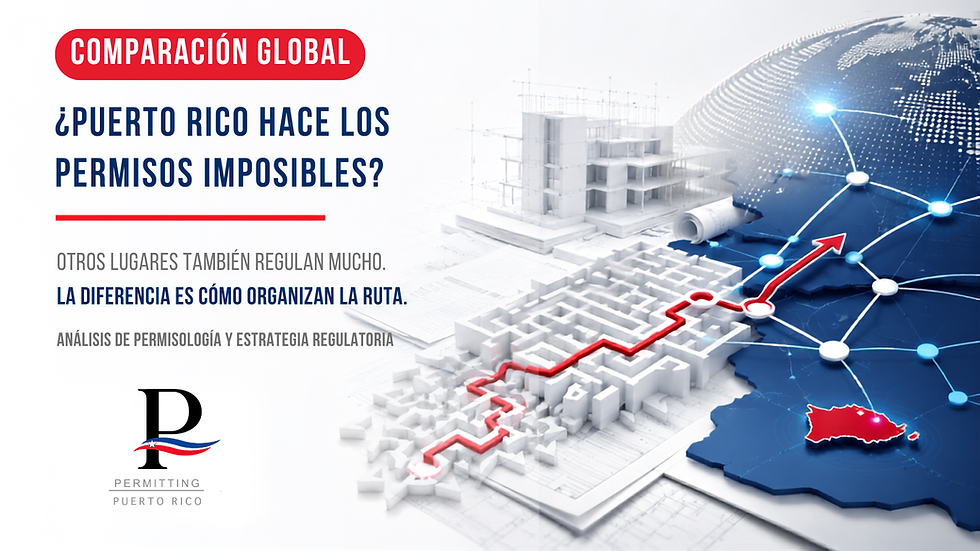
However, after more than 25 years working in government affairs, regulatory compliance, and permitting, my conclusion is more nuanced: Puerto Rico is not the only jurisdiction with demanding regulations. What sets us apart is how difficult it can be to understand and navigate the path forward.
The systems that work best do not necessarily have fewer rules. They have better-coordinated processes, clearer responsibilities, and more transparent expectations for applicants.
The Problem Does Not Begin When an Application Is Filed
Many people believe that obtaining a permit simply means completing an application and uploading documents to a platform. In reality, filing is only one part of the process.
Before submitting an application, several strategic questions must be answered:
Is the proposed use allowed on the property?
Does jurisdiction lie with OGPe or with an autonomous municipality?
Is a preliminary consultation, recommendation, or additional authorization required?
Are the plans, certifications, and corporate documents consistent with one another?
Are there environmental, historic, roadway, or infrastructure conditions that could affect the project?
Which process must be completed first to prevent another from stalling?
When these questions surface only after filing, correction notices, additional information requests, and weeks—or months—of uncertainty begin.
Puerto Rico’s own Final Report of the Task Force for the Simplification of the Permitting System recognized the structural scale of the problem. It identified approximately 46 separate legal instruments and 45 laws delegating authority to different agencies. The report describes a fragmented system and notes that basic processes can take between nine and eighteen months.
That official assessment confirms what professionals and applicants experience in practice: the complexity lies not only in the number of requirements, but also in how dispersed and poorly coordinated they are.
Singapore: Coordinate Before Correcting
Singapore did not eliminate agencies or technical requirements. Its CORENET X platform reorganizes regulatory approvals for construction projects into three main stages, or gateways.
At each stage, the relevant agencies review the project collectively and in a coordinated manner. The goal is to resolve fundamental decisions during the early design phases and reduce conflicts later.
The lesson for Puerto Rico is powerful: efficiency does not depend on approving everything automatically; it depends on having reviewers work along the same path and at the right time.
A poorly coordinated project can accumulate plans that appear correct individually but do not work together. Identifying those conflicts early protects time, capital, and credibility.
Miami-Dade: Multiple Disciplines, a More Visible Path
Miami-Dade also requires construction, zoning, mechanical, electrical, plumbing, fire protection, and other discipline-specific reviews, depending on the project.
The difference is that its portal allows plans and documents to be submitted electronically to multiple departments for review. Applicants can better understand which disciplines are involved and track the file’s progress.
This does not mean every permit is fast or every application is approved during the first review. Corrections, fees, and requirements from other entities may still apply. But the process architecture recognizes something essential: multiple reviews should not automatically become multiple disconnected paths.
New Zealand: A Deadline Exists, but a Complete Application Matters
In New Zealand, the local authority generally has 20 working days to process a complete building consent application. If additional information is needed, the authority may pause the clock while the applicant responds.
This model offers two lessons.
First, a defined timeframe creates a measurable expectation. Second, a clock cannot compensate for an incomplete application. When information, studies, or documents are missing, the process stops.
That is why efficiency is not solely the government’s responsibility. Good permitting management begins with a coherent, complete, and well-prepared file. Filing before a project is ready can create a false sense of progress while avoidable delays accumulate.
Estonia: Digitize the File, Not Just the Form
Estonia allows building permit applications and related documents to be submitted electronically through a national building registry. Local authorities still play a decision-making role; technology does not replace regulatory judgment.
What matters is that the registry serves as a common point for project information. This improves traceability and reduces dependence on isolated files.
There is another important distinction here: digitization is not merely converting a paper form into an electronic one. True transformation connects information, participants, decisions, and follow-up.
So, Does Puerto Rico Make Permits Impossible?
I would not say permits are impossible. I would say that, far too often, the system forces applicants to become interpreters of a structure that was not designed around their experience.
Puerto Rico has capable professionals, digital tools, and mechanisms that can work. It has also begun to officially recognize the need to simplify, integrate, and modernize. But as long as regulations remain dispersed, jurisdiction varies, and processes do not always move in coordination, improvisation will remain costly.
The right question is not simply: “How long will the permit take?”
First, we must ask:
What is the applicable path?
What could stop it?
What information must be validated before filing?
Who will be responsible for coordinating and following up?
Without those answers, any timeline is little more than an aspiration.
Permitting Must Be Managed as Part of the Project Strategy
A permit is not an isolated task to address at the end. It can affect property selection, design, budget, financing, opening date, contracts, and even eligibility for certain incentives.
That is why I recommend incorporating regulatory strategy from the beginning. Before signing a lease, purchasing a property, ordering equipment, or announcing an opening date, it is wise to evaluate the proposed use’s feasibility and the permitting path.
That early assessment does not guarantee approval—no responsible professional should promise one—but it does support informed decisions, reduce errors, and help anticipate risk.
PermittingPR: Turning Complexity into a Clear Path
At PermittingPR, we help business owners, property owners, investors, and developers identify the correct jurisdiction, organize requirements, and manage the process with strategic follow-up.
Our work is not limited to submitting documents. It involves understanding the project, interpreting the regulatory framework, anticipating dependencies, and keeping the client informed.
Because the true value of experienced management is not a promise that obstacles will never arise. It is the ability to identify them early, respond with sound judgment, and keep the client from navigating the process alone.
Permitting challenges should not stop a good idea for lack of direction.
If you are evaluating a property, starting a business, or developing a project in Puerto Rico, let’s talk before uncertainty turns into delay.
PermittingPR
One team. One point of contact. Greater peace of mind.


Comentarios